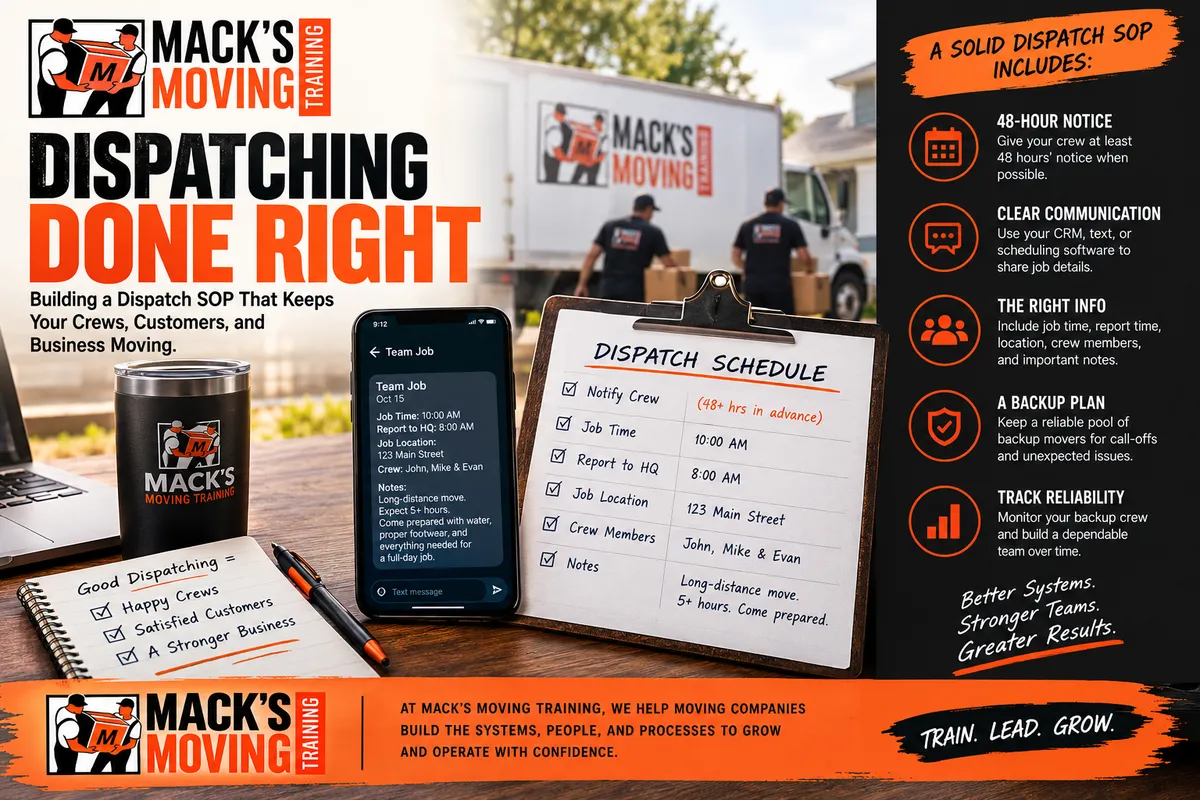
Dispatching Done Right: Building an SOP That Keeps Your Crews Moving
Dispatching Done Right: Building an SOP That Keeps Your Crews Moving
Dispatching can look completely different from one moving company to another.
A small two-truck operation may manage its schedule with a group text and a calendar. A larger company may have a dedicated dispatcher, CRM, automated notifications, and multiple crews running every day.
That’s the reality of the moving industry: we’re fragmented, and there is no one-size-fits-all approach to dispatching.
But regardless of your company size, one thing should remain consistent:
You need a dispatch process.
A good dispatch SOP eliminates confusion, gives your crews clear expectations, and helps your operation prepare for problems before they happen.
Start With a 48-Hour Notice
Whenever possible, your crew should receive their assignment at least 48 hours before the job.
This can be sent through your CRM, scheduling software, text message, or whatever communication system works best for your company.
The technology isn't the important part.
Consistency is.
Your crew should know:
What time the job starts
What time they need to report to headquarters
Where the job is located
Who they're working with
Any important job notes
A Simple Dispatch Template
TEAM JOB — OCTOBER 15
Job Time: 10:00 AM
Report to HQ: 8:00 AM
Job Location: Syracuse, NY
Crew: John, Mike & Evan
Notes:
Long-distance move. Expect approximately 5+ hours. Come prepared for a full-day job.
Simple. Clear. No guessing.
And you've already eliminated some of the questions you're likely to receive:
"What time is the job?"
"Where are we meeting?"
"Who am I working with?"
"How long is this one?"
Don't Stop at 48 Hours — Send a 24-Hour Reminder
The 48-hour notice gives your crew time to prepare, but people forget. Schedules change. Life happens.
That's why a second notification 24 hours before the job can be extremely valuable.
This isn't necessarily a completely new dispatch. It's a confirmation.
Example:
REMINDER — TEAM JOB TOMORROW
Job Time: 10:00 AM
Report to HQ: 8:00 AM
Job Location: Syracuse, Ny
Crew: John, Mike & Evan
Notes:
Long-distance move. Expect 5+ hours. Come prepared.
That 24-hour reminder gives your crew one last opportunity to identify a conflict or problem before the morning of the move.
It also helps eliminate the:
"I forgot I was scheduled."
problem.
Your Dispatch Communication Could Be Simple:
48 Hours Before: Full job assignment and expectations.
24 Hours Before: Confirmation and reminder.
Day of Job: Confirm the crew is where they're supposed to be and ready to work.
The goal isn't to over-communicate. It's to eliminate surprises.
What Happens When Someone Doesn't Show?
This is where your dispatch SOP needs a backup plan.
If reliability has been an issue for your company, don't wait until someone calls off to start looking for a replacement.
Build your backup system before you need it.
Create a reliability pool or backup list that tracks:
Who is available for emergency coverage
Who has successfully covered previous jobs
How quickly they can respond
Their reliability history
Which areas they can service
Who is currently available for standby
Over time, you're building something extremely valuable:
A reliable backup workforce.
Consider a Formal Standby System
Depending on your company's structure and applicable employment/contractor rules, you may consider creating a formal standby policy.
For example, one mover could be designated as the day's backup. That person might report to headquarters or remain available nearby.
If you require someone to remain available, make sure you have a clearly communicated compensation policy for that standby period and any work they are called in to perform.
The exact structure will vary by company.
The important part is having a policy.
Everyone should know:
"If I'm the backup today, here's what that means."
That removes confusion for both the company and the mover.
Track Your Backup Reliability
Here's where dispatching becomes more than simply putting names on a calendar.
Start tracking your backup performance.
Mover | Backup Dates | Called In | Response Time | Showed | Reliability |
|---|---|---|---|---|---|
John | 5 | 2 | 15 min | Yes | Strong |
Mike | 4 | 1 | 45 min | Yes | Good |
Evan | 6 | 3 | 10 min | Yes | Strong |
It doesn't have to be complicated.
A simple spreadsheet can tell you who you can actually count on when things go sideways.
Over time, you can build your own reliability pool based on actual performance instead of simply assuming someone is dependable.
Build Your Dispatch SOP
At minimum, your dispatch process should answer five questions:
1. When are crews notified?
Example: 48 hours before the job.
2. How are they notified?
CRM, text, app, email, or another consistent system.
3. What information do they receive?
Job time, report time, location, crew members, and important notes.
4. What happens if someone can't make it?
Follow a clearly defined backup and replacement process.
5. Who owns dispatch?
One person should ultimately be responsible for the schedule and communication.
The larger the company becomes, the more important that last question becomes.
Dispatch Shouldn't Depend on One Person's Memory
The purpose of an SOP isn't to make dispatch complicated.
It's actually the opposite.
You want a process where any properly trained dispatcher can look at the schedule and understand exactly what needs to happen.
That's how small companies grow into bigger companies.
You don't necessarily need better people.
Sometimes you simply need better systems.
The Takeaway
Your dispatch process should create three things:
Clarity for your movers.
Confidence for your customers.
Control for your business.
Start simple.
Give crews 48 hours' notice.
Follow up with a 24-hour confirmation.
Give them the information they actually need.
Create a backup pool.
Track reliability.
Establish a clear call-off procedure.
Then refine the process as your company grows.
Because when busy season hits again, you don't want to be asking:
"Who's working today?"
You want your system to already know.
Mack's Moving Training
At Mack's Moving Training, we believe growing a moving company isn't just about getting more jobs. It's about building the systems, people, and processes that allow your company to handle those jobs consistently.
Train. Lead. Grow.
If you found this Blog to be helpful Visit us at Macksmovingtraining.com for more helpful tips or read more Blogs
We are your #1 Source for Moving Company Training not just Mover training.